

Sudden purchase without a clue
Usually I aim not to buy things impulsively. When a product gets my attention, it's added to the wishlist and I set a target price for myself. When this price is reached, I decide whether to buy the product or remove it from the list. Usually. And then the Hasbro Beyblade X Xtreme Battle Set was discounted while I was buying more or less useful things for my girlfriend's advent calendar.
The set arrived home two days later and I was as happy as a small child. I unpacked it straight away and played with it. My girlfriend wasn't as thrilled as me, but I managed to talk her into a few rounds. We launched the Beys into the arena using the included launchers and watched them dance around each other and collide, until one of them stopped spinning or was thrown out of the arena. But as quickly as the excitement had come, it faded again, and the arena, along with the Beyblades, ended up in the cupboard.
Not only digital
I'm a gamer and a nerd. I love playing video games and doing all sorts of stuff connected to computers. Optimising my system, vibe-coding some software, or tinkering with my hardware. But these are all digital hobbies, or just solitary activities. Because of this, I have been looking for a physical hobby that fits my personality for several months now. Three things came to mind: Magic: The Gathering trading cards and competitions, Warhammer 40,000 tabletop, or TTRPGs. TTRPGs were too nerdy for me. Warhammer 40,000 is a big investment of time, money and space. Not a hobby you just start and try out. Painting the models, building the battlefields, playing campaigns for hours. That's too much for me.
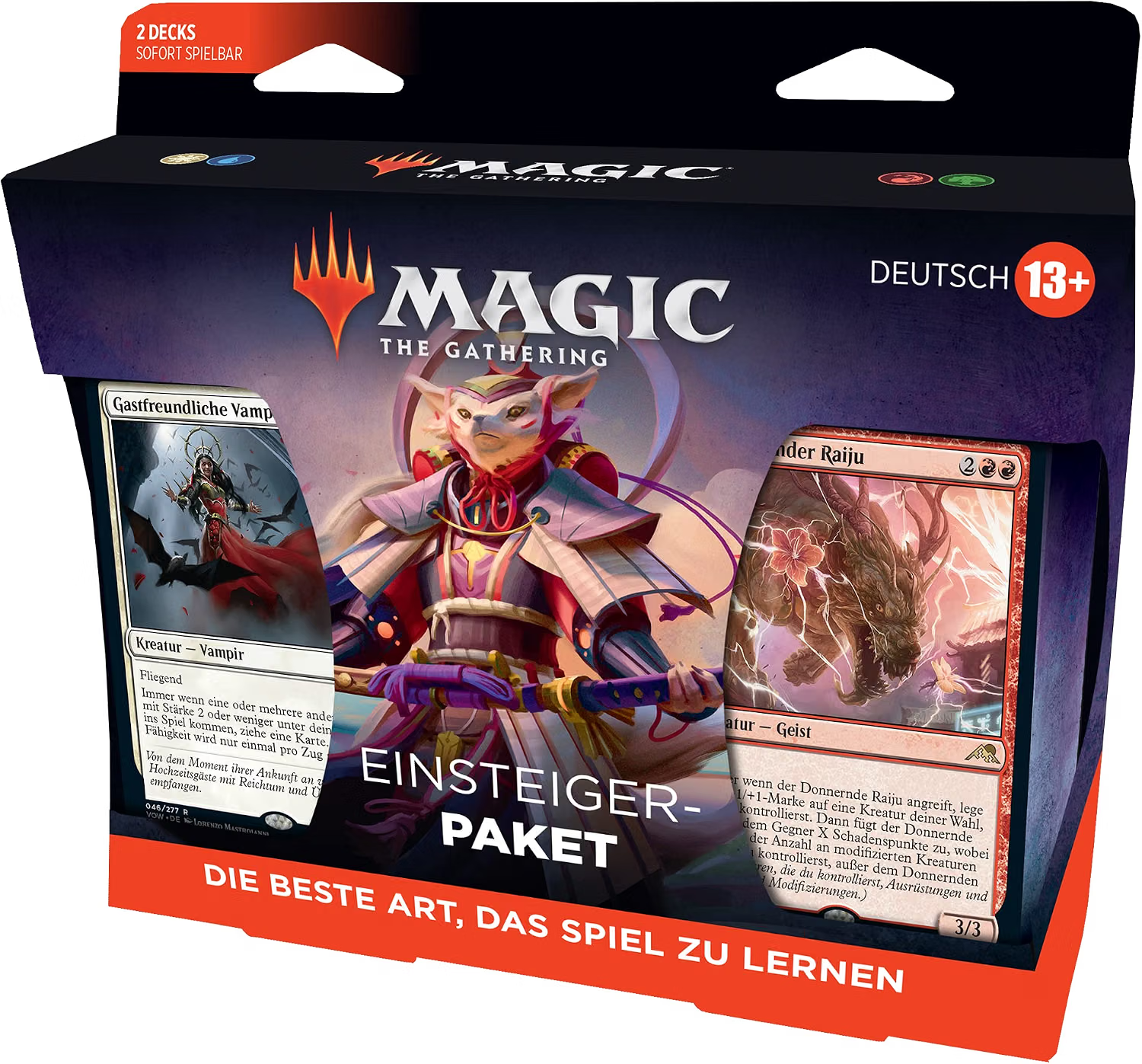
So I decided on Magic: The Gathering. A starter set was quickly ordered and the urge to collect was awoken. Over the following two years, additional sets from discounts were added, and I played a few games against my girlfriend during that time. But the lack of spare time and other priorities kept me from getting deeper into the topic. One day I wanted to catch up and started to delve deeper into Magic. And the deeper I dug, the less I understood. Commander? Deck building? Editions? Booster packs or specific cards? Simple rules, but thousands of skills, traps, effects, spells and interactions. I also tried the digital variant Magic Arena, and was none the wiser for it.
Just turning up to an event and playing doesn't seem possible. One has to invest time and money. I had already invested over 100 euros and still had no deck to seriously play against others.
At that point I was somewhat frustrated and flopped down on my sofa. From there, my gaze fell on the Beyblade X arena. Does anybody really play Beyblade seriously? Are there meet-ups like for Magic? And if so, are there also grown-ups?
Surprising Beyblade X community
I instantly fired up a search engine to get an overview. The topic is surprisingly more complex than I expected at the start. Beyblades have existed since 1999 in Japan and were brought to the West in 2002 by Hasbro. I'm not sure if the physical Beyblades were just merchandise for the anime, or if it was the other way round and the anime was meant to boost sales of the Beyblades.

The X already made me guess that there are multiple generations, of course all somehow different and incompatible. The original generation was still a pure plastic toy, but was succeeded by the Metal Generation nine years later. With this generation lasting just four years, the Burst Generation was released after a break, in 2015. Again partly made of metal, but now with the chance of the Beyblades breaking apart into their parts on collision. Since 2023 the newest variant, X, has been on the shelves, now with gears on the Bey and in the arena for faster action.
Beyblade as a brand is more active than I expected. But are there really tournaments? Surprisingly, yes. There is a mix of community and official tournaments. The official ones are run by the manufacturers and are on a national level. The winners of these tournaments qualify for international events.
The community events, on the other hand, are also remarkably well organised. There is an official platform with leaderboards, and in principle any active blader can become an organiser by application. They may then run ranked tournaments, provided at least four players take part and a certified judge is present. For a spinning-top sport played in small groups, this is unexpectedly bureaucratic and standardised, overseen by the community platform World of Beyblade. And yes, there are plenty of grown-ups among the Beyblade fans, most likely long-time players.
The Beyblades
The Beyblades, called Beys, are diverse too. At first one might believe they are just cheap merchandise toys, like the first generation likely was. But with the current generation, this conclusion is far too short-sighted. Every Bey consists of at least three parts. At the very top is the Blade, which is the heavy, solid metal body. Below that is the Ratchet, which connects the Blade to the Bit. The Bit is the contact surface, or the tip of the spinning top.
Every Bey consists of these three parts and always comes complete. However, the parts are not fixed and inseparable, but can be freely combined. This makes sense, since there are various versions of each part with different characteristics. For example, some Blades are heavier or have more jagged edges, Ratchets can grip tighter or be taller, and Bits have flat, round, or otherwise shaped tips.
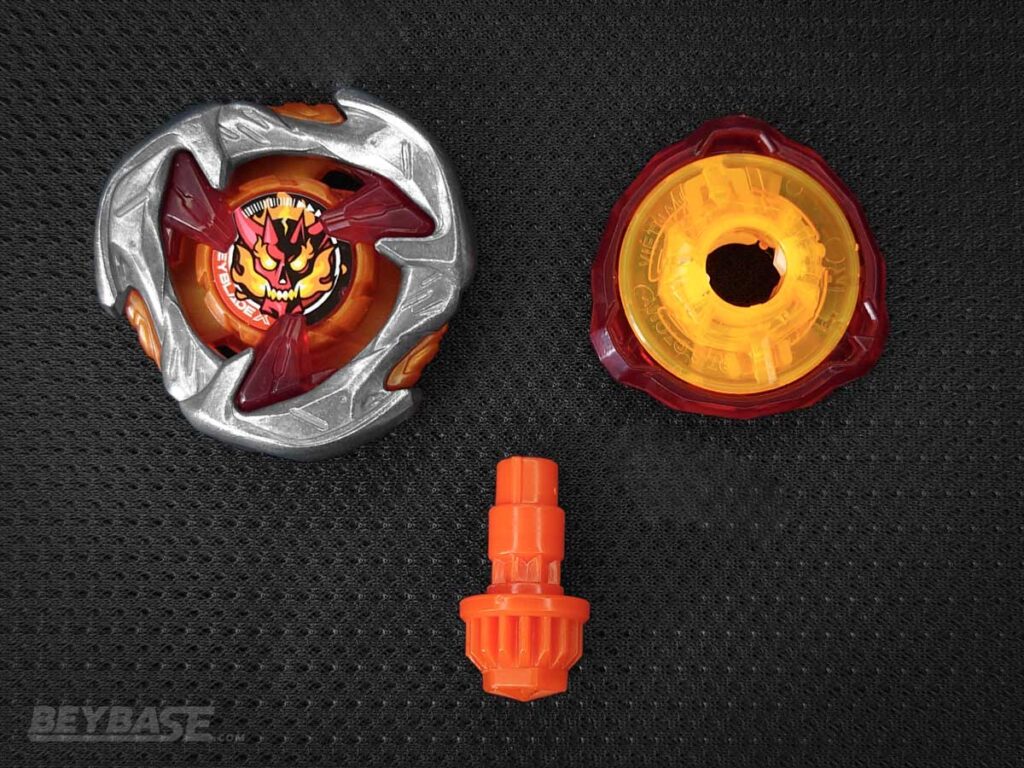
This makes it possible to assemble your own Bey and actively determine its characteristics. A more angular Blade for attack, with a flat Ratchet to hit the opposing top more on the underside, with a more pointed Bit for more dynamic movements. Depending on the configuration, the Beys are then divided into Attack, Defence, Stamina, and Balance. Attack actively tries to knock the opponent over or throw them out of the arena, Defence tries to brake the opponent to a standstill, Stamina ignores the opponent and spins for as long as possible, Balance is somewhere in between.
In terms of build quality, the Beyblades are surprisingly good. The Blades consist of cast metal, the rest of plastic, I suspect ABS. The launchers are also made of plastic and are available in various versions. However, only one feature is truly different: the pull system. With one type, you push a jagged plastic stick into the launcher and then pull forcefully. The other type is a pull cord, which retracts back into the launcher after the launch.
The launcher hooks into the top of the Bey in the direction of rotation using three L-shaped hooks. This causes the hooks to automatically slip out when the launcher spins slower than the Beyblade, releasing it.
The Gameplay
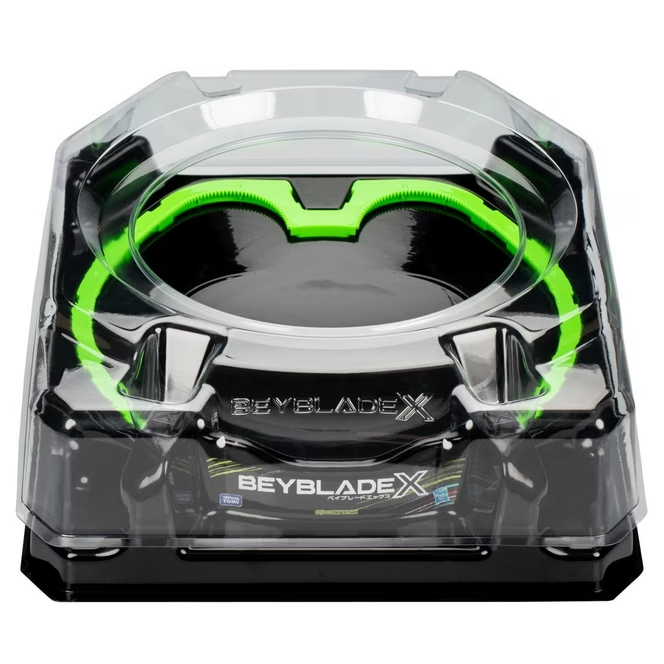
It is normally played by two players. Each chooses three Beys in advance and their order. Then the starting signal is given via a countdown and the famous "Let it rip". Both players pull their launchers and the Beyblades fall spinning into the arena. This is a shallow bowl, protected by a cover made of transparent plastic. On one side, there are also three zones that count as out of bounds. And then there is the gear ring, which converges towards the centre on one side. This is new in the X Generation. When a Bey touches it, the gears on the Bit hook into the rail and the Bey is shot around the arena into the centre. In the best case, it hits the opposing Bey with force there and attacks it.
The game is played with three designated tops until one player has four points. Different types of victories award different amounts of points. There is only one point if your own Bey spins longer than the opponent's. More points are awarded if you knock the opposing Bey out of the arena or even dismantle it into its individual parts. Yes, the Beys can fall apart, depending on the strength of the Ratchet. But that's not exactly easy; the parts are connected quite firmly to each other.
The fact that it still works and also happens regularly shows how much power is actually in the tops. When you see an Extreme Dash, the acceleration via the gear ring, with a subsequent collision, you are amazed at how violently the whole thing happens. I wouldn't want to have my fingers in between. Certainly not dangerous, but definitely painful.
What's next
So it became clear to me that the two Beyblades from the starter set are not enough. For a competition, you need at least three tops. Added to this is the collecting factor and the combining of different parts. The great thing is that the parts of any Beyblade can be swapped with those of other Beyblades. Prefer a flat bit instead of the included round one? If you have a flat one, you are allowed to swap it. Currently, there are 50 Beys, 22 Ratchets, and 35 Bits in Europe. This means theoretically 38,500 different combinations are possible. If you had all the parts...
But the tournaments are certainly more exciting. I haven't participated in one yet. But according to my research, there are at least two regular events in my immediate vicinity. I will certainly take part there soon, and beforehand work out what the best combination of my five Beyblades so far is.
I am excited and will keep you updated here. Perhaps an insight into the world of Beyblade X competitions interests you too.